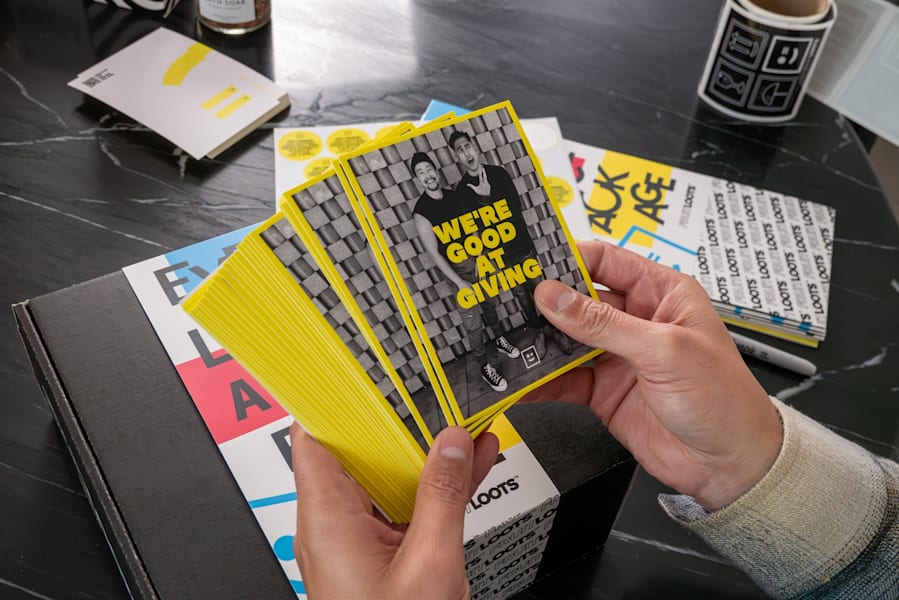
Print marketing materials are one of the simplest ways to make your business feel real, memorable and established – right from day one.
Whether you’re launching a new brand or looking for fresh ways to stay visible in your community, printed marketing collateral helps you connect with customers in a tangible, trusted way. From business cards and flyers to packaging, signage and direct mail, print gives people something they can hold onto (and act on).
In this guide, we’ll break down the most effective types of print marketing materials, explain why they still work so well alongside digital marketing and share practical tips for choosing the right assets at every stage of growth – so you can promote your business with confidence.
- Print marketing materials (also known as printed marketing collateral) are physical, printed pieces that promote your business, communicate an offer or help customers take action.
- The biggest benefits of print marketing are stronger brand recall, higher trust, less competition than digital and more chances to get in front of the right people locally.
- The most popular types of print marketing materials include business cards, brochures, flyers, posters, banners, direct mail, catalogs, packaging, promotional products, branded clothing, door hangers, billboards and wall decals.
- To create effective print marketing materials, you need to match each piece to your audience and business stage, keep the message clear, use a strong call to action and design for brand as well as quick readability.
- To bridge the gap between print and digital assets, use QR codes or short links that send people to one specific next step, like booking, ordering or getting directions.
What are marketing materials?
Marketing materials, or marketing collateral, are any assets you use to promote your business, communicate your value or encourage customers to take action – whether that means visiting your website, calling you, stopping by your store or making a purchase.
There are two main categories of marketing materials.
- Print marketing materials are physical materials people can hold, keep and share.
- Digital marketing materials are online assets people view on screens.
What are print marketing materials?
Print marketing materials, also known as print collateral, are anything that’s printed to promote a business and its products and services. This includes things like brochures, flyers, business cards, posters, direct mail, packaging, promotional products and catalogs.
5 reasons why print marketing materials are important

1. They’re still effective
You might be wondering why print marketing materials are still around in our digital age. And that’s a good question.
Print marketing is still around because it’s still effective. In fact, so effective that, according to the RRD Print Impact Report, 94% of marketers say they’re using print to overcome digital fatigue.
2. They promote brand awareness
Print marketing materials give people a stable, physical layout that’s easier for the brain to “map.” When someone reads in print, they’re more likely to retain not just what they saw, but where they saw it – which supports recognition and recall later.
People’s ability to remember the location of information is significantly poorer when reading on a screen than in print.
A 2025 study published by Springer Nature found that people remember information from print better than digital. That kind of recall advantage helps explain why print can create stronger brand touchpoints. When your logo, offer and key message are placed clearly on a physical piece, it’s easier for customers to recognize your business and remember it.
3. They work well with digital marketing
All of this doesn’t mean print should replace digital – it works best as a partner to it. Print helps you build trust, stand out locally and create memorable brand touchpoints, while digital makes it easy to take the next step, track performance and stay engaged.
RRD’s Print Impact Report found that 91% of marketers with print programs are strategically integrating print and digital channels, and 50% use QR codes in their print marketing and expect that to continue.
4. They build trust
Print collateral helps you establish local brand recognition by connecting you with the local community, building the trust and loyalty that are indispensable for long-term success.
And, while digital is great for reach and tracking, trust in online advertising can lag. In fact, Advertising Association data shows that among older audiences, trust is particularly low (for example, only 14% of over-55s trust online ads, and just 7% trust social media ads). Considering the rapid pace of AI adoption in digital channels, the future level of confidence in online advertising may shift considerably.
That’s why print can be such a strong complement to digital marketing: a well-designed business card, flyer, brochure or in-store sign gives people a tangible brand touchpoint that feels local, real and easier to trust.
5. They help you stand out
And in a digital space that’s swarming with competition, adding print collateral to your marketing strategy can help you to stand out from the rest, giving you a competitive edge – especially if you get a little more creative.

Tips for using print marketing materials effectively
Here are some tips to use your print marketing collateral effectively and maximize your return on investment.
Understand your audience
Think about who your target audience is, what their desires and pain points are, where they’re based and at what stage of the buyer’s journey they are in.
The buyer’s journey describes the stages a person goes through to make a purchase:
- Awareness: The buyer is aware that they have a problem.
- Consideration: The buyer researches the different approaches to solve that problem.
- Decision: The buyer evaluates various businesses and decides which to purchase from.
Knowing exactly where your target audience is on the path to purchase will influence your choice of print collateral and how you design it.
Tailoring print marketing materials to match the preferences and behaviors of your target audience increases their effectiveness.
Choose the right print marketing materials by your business stage
Once you understand who you’re trying to reach, the next decision is practical: what should you print first, and what can wait.
Match your marketing materials to your business stage. Your needs at launch are different from your needs when you’re growing, and different again when you’re scaling. When you print for the stage you’re in, you avoid wasted spending, stale stock and materials that look nice but don’t get used.
Launch: Get the basics into circulation
At launch, you’re building presence. You need printed marketing materials that help you introduce yourself quickly and show up in the places your audience already is.
- Prioritize portable handouts: Stick to simple visibility pieces.
- Print for two weeks of real-world distribution: If you can’t picture handing out 50–100 pieces in the next 14 days, scale the quantity down.
- Put a small stack anywhere your audience already goes: Good locations near you may include a friendly café, barber shops, the gym, coworking spaces, local boutiques, the community center, at the front desk or checkout counter.
A practical approach is to choose one “handout” (business card or flyer) and one “leave-behind” (postcard or small brochure). That covers quick encounters and slower consideration without stretching your budget.
Good launch materials get used in the real world without effort. If you have to “figure out a whole campaign” just to distribute them, they’re usually not the right first pick.
Growth: Support momentum and make follow-up easy
When you’re growing, print is at its best when it supports the customer experience: at the counter, in the bag, at the doorstep and in the mailbox. Your goal is to stay visible after the first interaction without having to chase people down.
- Build print into your routine: Add a thank-you insert to every order, keep referral cards at the counter and leave one-page service menus where customers naturally pause (waiting area, reception desk, fitting room, checkout).
- Keep one “evergreen” offer in circulation: For example, try an evergreen promotion like, “Bring this back for 10% off your next visit” or “Free add-on with your next booking.”
- Reorder to prevent gaps in contact: When you hit your last 20–30 cards/flyers/inserts best to restock to keep a consistent flow of communication at all stages of your customers’ buying process.

At this stage, it’s better to use a few formats constantly than to add new ones you only remember during promotions.
Scale: Standardize and build repeatable kits
When you’re scaling, the goal is to create a reliable experience across every location, channel and customer touchpoint. You want a core set that stays consistent, plus campaign materials that you can roll out quickly.
- Create a “core pack” you always keep on hand: Business cards, a one-page overview (menu/service sheet), basic signage and packaging elements (labels, stickers, inserts) if you ship or bag products.
- Create a simple campaign kit template: A poster, a counter sign and a small handout (flyer/postcard). Then you only swap the offer and dates each time you run a promotion.
- Match quantities to how fast you can distribute: If a location goes through 200 flyers per month, don’t print 2,000 “to save money.” Print what you can actually place in 4–6 weeks so your message stays current.

If you’re expanding into a new area, standard print makes you look established quickly, even before word-of-mouth kicks in.
| Business stage | Business goal | Print items to prioritize | Best starter set | Where to use | What to avoid |
|---|---|---|---|---|---|
| Launch | Get known locally | One handout & one leave-behind | Business cards & flyers (or postcards for neighborhood drops). Simple signage if you have a location. | Pop-ups, local boards, partner counters, community spots, neighborhood handouts | Big quantities, complex formats, anything you can’t distribute within two weeks |
| Growth | Turn first-time buyers into regulars | Materials that fit into daily operations | One-page menu or service sheet, packaging inserts, referral cards & postcards for local drops | Checkout counters, deliveries, waiting areas, service visits, referral moments | New formats you won’t use weekly, expensive pieces you’ll need to update often |
| Scale | Consistency & faster campaign rollouts | Standard core pack & repeatable promo kit | Core pack (cards, one-pager, signage, packaging basics) & promo kit template (poster, counter sign & handout) | Multi-location environments, partner distribution, seasonal promotions, events | Overstocking, too many variations, one-off runs that slow down reordering |
Create clear messaging and benefits
Clarity is always key.
Good marketing materials make it easy for your audience to understand what they need to know.
For example, if you’re opening a store, you’ll want to make it clear what you sell, when it’s opening and where it’s located. Think who, what and where.
To make your advertising persuasive, also think about the why: Always lead with the benefits of your product or service. Center your messaging around what’s in it for your target audience, and you’ll be making a compelling case for them to purchase from you.
Include a call to action
Once they read your print collateral, your audience should know what to do next.
A call to action is made up of a few words that tell a person what to do after reading, whether it’s visiting your website, making a call or swinging by your store.
They’re usually a command. You’ll be familiar with calls to action such as “Order now” and “Book now.”
Keep it clear and simple to be effective.
Use eye-catching design
One of the most important aspects of print marketing is visual design.
Good design captures attention and highlights key information without overwhelming your target audience. It should guide the eye in a clear order, so someone can understand what you’re offering at a glance – even if they only look for a few seconds.
Start by deciding what the one thing is that you want people to notice first. Then build the layout around that.
A simple way to do this is to create a clear structure:
- Headline first (what it is/what you’re promoting)
- Key detail next (the offer, the event, the service, the price range – whatever matters most)
- Supporting info last (the essentials people might need before they act)
Consider using design principles such as visual hierarchy and contrast to make your marketing materials stand out from the crowd and get your message across. Hierarchy is what makes the important information feel obvious. Contrast is what makes it readable from a distance and in different lighting.
A practical check before you print is to hold the design at arm’s length (or zoom out on screen until it’s roughly that size). If you can’t immediately spot the headline and the key detail, simplify.
If you’re designing the collateral yourself, remember that most applications will default to RGB color mode, which is for digital projects. For print, use CMYK color mode; otherwise the colors can look different once printed.
Also, design with print production in mind:
- Add a safe zone around the edges so nothing important gets trimmed.
- Keep small text away from the edges, and avoid placing logos right on the cut line.
- If you’re using photos, make sure they’re high quality so they don’t look blurry in print.
Remember that good print marketing reinforces your brand identity. To do that, maintain consistency with your brand colors, fonts and overall look so your business is easy to recognize across every piece of printed marketing collateral.
Integrate print with digital
Print can do a lot of heavy lifting on its own, but it gets even stronger when it connects to your digital channels. That’s where business QR codes come in. Used well, they turn a quick glance at your print marketing materials into a clear next step online that you can track.
The key is to treat the QR code as a direct route, not an extra: someone scans – they land – they act. The destination should match the exact promise of the printed piece in their hand.
- Link to one specific action: A booking page, a quote form, a menu, a product collection, directions or a new-customer offer – there should be just one goal for each printed piece.
- Match the link to the moment: A flyer from a local event should lead to an event-related offer. A business card should lead to a simple contact-and-services page. Packaging should lead to reordering, care instructions or support.
- Use different QR codes for different campaigns: If you change the offer, change the code. That’s how you’ll know which print marketing materials examples actually drive results.
- Label the value clearly: Use easy-to-understand CTAs, like “Scan to book,” “Scan for today’s menu,” “Scan for 10% off.” People scan when the payoff is obvious.

A few details prevent wasted prints:
- Send scans to a mobile-friendly page with fast load, easy buttons and a clear next step.
- Test the printed asset with a QR code by scanning it in bright light, low light and from a comfortable distance.
- Keep the code away from the edge and avoid placing it over busy backgrounds.
- Add a backup in the form of a short, readable URL underneath for anyone who prefers typing.
Measure and adapt
Print marketing works best when you keep it simple: one goal per piece, one way to track it.
Start by choosing the action you care about most – calls, bookings, website visits, walk-ins, repeat orders, event attendance. If a piece has three goals, you’ll struggle to learn anything from it.
If you’re using QR codes or short links:
- Use a unique code/link for each campaign or distribution channel.
- Track scans, page visits, form fills, bookings and purchases.
- Note where the piece was handed out (event, partner counter, neighborhood) so you can compare results.
If you’re not using QR codes:
- Add a simple offer code people can say or type (“FLYER10”).
- Use a dedicated phone number for a campaign when calls matter most.
- Ask at checkout: “Where did you hear about us?” and keep the answers tied to your printed marketing materials.
Then adapt based on what you learn. Reprint the printed marketing collateral that consistently gets a response, shift distribution toward the places that perform best and retire anything that doesn’t get used, gets outdated quickly or drains your budget without results.
13 types of print marketing materials for your business
Let’s take a look at some of the different types of print marketing collateral, along with their pros and cons, so you can pick what’s best for your business.
1. Business cards
Business cards are a great way to share your essential contact information and make a strong impression with your brand.
They’re handy for networking and chance encounters with your ideal customers – making them a perfect solution for getting more leads for your business.
A good business card can set you apart from the rest and put you front of mind when a potential customer has a problem that you can solve.
Business cards can leave a lasting impression of your brand. If you’re a luxury or high-end brand, your cards can convey that premium feel by using a more solid material like a thicker matte paper, plastic or metal.
What’s great about business cards is that you can design them with a tactile quality that helps boost brand retention.
Just make sure the material you choose communicates something about your brand. If sustainability is a core value, you can make your business cards out of brown recycled paper, bamboo or hemp.
Or impress others with business cards that use near-field communication, so that people can scan your cards with their phones to get your contact information.
You can get creative with your business cards to stand out and show what you’re about.
If you’re stuck for ideas, research unique business card designs for inspiration.
Pros
- Can create a lasting impression even with a brief encounter
- Easy to customize
- Affordable
- Portable
Cons
- Limited space for information
- Easy to lose
- Easy to damage, depending on the material
Business card design tips
- Put the most important contact method first: What’s most important? It depends on the business type – a phone number for services, website address for ecommerce, street address for retail. Don’t make people choose between five options.
- Use the back for one clear job: One option is to include a QR code to book, save contact, or view a menu. Another is to include a short list of services.
- Choose a finish that fits how it’ll be handled: Matte stays readable under bright light. Gloss looks punchy but can make small text harder to read.
- If you use a logo, keep it sharp and simple: Tiny, detailed logos often turn into a blur once printed.

2. Brochures
Brochures are versatile marketing materials which allow you to share more detailed information in a visually appealing way. Use them to highlight specific products, services or promotions you offer.
They’re folded sheets of paper that come in various sizes, such as bi-fold, tri-fold or multi-page formats, giving you the flexibility to say what you need to.
Brochures can be distributed through various channels like direct mail, in-store rack displays, trade shows, events or alongside products during a purchase.
Pros
- Versatile
- Space to give more information
- Affordable
- Can be turned into digital marketing assets as PDFs
Cons
- Can quickly become outdated if you have regular changes to your products and services
- Takes a bit more design time to get them right compared to simpler formats
Brochure design tips
- Treat the front panel like a hook: We recommend one promise + one strong visual. Save details for the inside.
- Use clear sections with short headings, so it’s easy to skim: Be sure your brochure covers What you do, who it’s for, what to do next.
- Keep your strongest offer on the inside right panel: This is where eyes naturally land when opening the pamphlet.
- If you include pricing, design it so it can be updated later: Avoid weaving prices into big blocks of copy.
Learn more about designing, printing and using brochures with our full guide to brochures for small businesses.

3. Flyers
Flyers are single-sheet promotional materials that are printed on one or both sides. They tend to be smaller in size, making them easy to hand out directly to people, pop in mail slots, pin on bulletin boards or add as inserts to newspapers or mailings.
They usually contain some brief information about a business, its products, services, events, sales, special offers or promotions. They come in various sizes and designs, ranging from simple handouts to more elaborate, visually engaging layouts. The flyer category can be fairly broad. To help you understand which flyer will work best for you, we put together a flyer overview.
Pros
- Budget friendly
- Quick to distribute
- Ideal for promoting events
Cons
- Limited space for content
- Some recipients may discard flyers without reading them
Flyer design tips
- Build around a single focal point: Whether its an offer, event or benefit, flyers work best when they feel instant.
- Use a bold headline and one supporting line: Let the details sit lower on the page.
- Leave enough space for the important bits: A crowded flyer looks cheaper than a simple one.
- Make the important information impossible to miss: If it’s for an event, make the date, time and place obvious. If it’s a sale, make the offer, date, and location obvious.
Find more actionable flyer design tips and learn how to design a flyer from scratch in our guide.

4. Posters
Posters are designed to capture attention from afar and convey a message quickly. They come in various sizes, but they’re bigger than flyers, giving them greater visibility that has the potential to reach a wider audience. But not always much bigger. The poster size options you choose will depend on the location and application of each poster design.
They’re typically displayed on walls, bulletin boards, storefronts and any areas with high foot traffic.
Posters are good for promoting special events, sales, product launches or important announcements thanks to their eye-catching nature and large size.
Pros
- High visibility
- Grab attention
Cons
- Can be tricky to find suitable spaces for poster display
- Printing large posters, or in color, can be more expensive than using other print collateral
If you’re using posters, make sure that you put them in places that are frequented by your customers to maximize their effectiveness.
Poster design tips
- Design for distance first: Your headline should be readable from a few steps away.
- Use a short message, large type and one strong visual: Posters don’t reward detail.
- Keep the call to action low and clear: “Scan to book,” “Visit today,” “Order online.”
- Avoid thin fonts and light colors: Posters often end up in mixed lighting and behind glass.
5. Banners
Banners are large-format marketing collateral made from durable materials such as vinyl or fabric.
They’re designed to be used both indoors and outdoors, since they can be made with weather-resistant materials.
Banners are larger than brochures, flyers and posters, but they come in a range of sizes. They can be displayed using stands and frames, and be hung or suspended.
Banners are excellent for outdoor advertising, promoting sales, announcing events or increasing brand visibility. You’ll often see them on street corners, in storefronts and entrances, and at trade shows and events.
Pros
- Highly visible and can attract attention from afar
- Great for the outdoors
- Durable
- Versatile
- Reusable, offering long-term value
Cons
- Larger banners need more space for storage when not in use
- Can be more expensive
- Hanging or installing large banners might need professional assistance or specific equipment
Banner design tips
- Keep the message very short: Use just five to seven words if you can (banners are glanced at, not studied).
- Use information hierarchy: Put the logo at the top, the offer in the middle and the call to action at the bottom.
- Prioritize high contrast and avoid fine detail: This is especially true if you plan to hang it outdoors or will be viewed at a distance.
- Leave extra margin space: Banners can crease, curl or be partially blocked depending on how they’re hung.
Find more actionable banner design tips and learn how to make a physical banner for your business in our step-by-step guide.

6. Direct mail
Direct mail involves sending printed promotional materials – like postcards, letters, catalogs and flyers – directly to your target audience through the post.
Direct mail is perfect for reaching specific demographics in certain locations. The best direct mail appeals to the preferences and needs of the recipients and can help you generate leads, drive sales or increase brand awareness.
You can use direct mail to advertise promotions, discounts, coupons and exclusive offers to encourage recipients to make a purchase.
Give your business a more professional, premium feel with any direct mail that you send by using letterheads and branded envelopes – this will enhance your credibility.
If you’re just starting out as a business, direct mail could be a good approach for raising awareness of your brand in your local area.
Pros
- Targets specific demographics, increasing the chances of reaching a receptive audience
- Measurable results
- Less competition
Cons
- Success depends on the accuracy and quality of the mailing list you use
- A large mailing list can be expensive to distribute to
Because they don’t come in envelopes, postcards are a better option for direct mail than sealed letters. Their message is instantly visible. Check out our postcard size guide for more mailing tips!
Direct mail design tips
- Lead with one clear reason to care: Focus on a limited offer, a strong benefit or a local hook.
- Make the offer easy to redeem: Simplify buying with a bold promo code, a tear-off style layout or a QR code that goes straight to the deal.
- Use big, friendly type: Direct mail gets read quickly, often while standing near the trash.
- Put your brand name and call to action on both sides: If it’s a postcard – people flip fast.

7. Catalogs
Catalogs and booklets are printed materials that allow you to showcase a collection of your products and services in an engaging way.
They can be excellent sales tools, encouraging purchases through copy, graphics, discounts and coupons.
They’re so effective, in fact, that 60% of recipients visit a catalog’s website.
Pros
- Showcase a range of products and offerings in one place
- Achieve high engagement that influences purchasing decisions
Cons
- Expensive to design and print catalogs
- Can become outdated quickly due to changes in products, pricing or offerings
Catalog design tips
- Organize products into sections that match how people shop: Common structures include information by category, use case or bestsellers.
- Give each product room to breathe: Include a strong photo, short description, clear price and a simple next step.
- Keep consistent photo style and spacing: This helps the booklet feel premium and makes it easy to scan.
- Add subtle navigation cues: Use page markers, icons or mini headers, so people can find what they want again.

8. Packaging
Packaging doesn’t just protect products from damage but can also promote your business and create an enjoyable user experience for customers.
Try putting a thank-you card inside the packaging. Or include a message inside the box that gives your customers tips for using your product.
You can also complement your digital marketing efforts by adding a QR code on the outside of the packaging that connects to your social media.
All of these little things go a long way when it comes to building a loyal customer base and a positive image for your brand.
Pros
- Builds a positive brand perception
- Strengthens relationships with customers
- Increases social media following
Cons
- Limited space
- Added expense of customizing packaging
Use packaging as an opportunity to delight your customers with an interesting unboxing experience, strengthening positive associations with your brand and setting you apart from the competition.

Packaging design tips
- Make the outside instantly recognizable: Design with your logo, brand colors and a clean layout that looks good in photos.
- Keep important details where they’ll actually be seen: Avoid placing key info on seams or folds.
- Add a small printed moment inside: Think about a thank-you message, care instructions or a reorder reminder.
- Link QR codes to the packaging experience: Direct customers to helpful resources like a how-to, reorder link or support page.
Check out our list of current packaging trends that you can incorporate into your packaging.

9. Stationery and promotional products
Creating visually appealing, high-quality stationery and promotional products helps reinforce your brand identity and professionalism. You can customize stationery like pens, folders, notebooks and highlighters or promotional products like mugs, water bottles, candy wrappers, chargers, mousepads and USB sticks.
Using stationery and promotional products can increase your brand’s visibility by giving people tangible reminders of you. For example, every time someone uses a branded pen of yours to write something down, you’ll pop into their mind, boosting brand retention and recall.
You can make a good impression on customers by including some useful stationery and promotional products for free with a purchase.
When it comes to print marketing, it’s all about using every available opportunity and space (no matter how small) to promote yourself, so you’ll be front of mind.
Pros
- Build long-term brand exposure and recall
- Can nourish customer loyalty and retention
- Give your business a professional image
- Enhance engagement and memorability
Cons
- Some items can be more expensive to customize
- Difficult to measure the return on investment

Stationery and promotional products design tips
- Keep branding minimal and intentional: A cluttered design gets ignored.
- Use one strong element: Make a statement with a logo, brand name or short tagline – then leave space.
- Match the product to how it’s used: A notebook needs branding that still looks good when it’s worn in.
- Choose colors that stay readable on the material: What looks great on screen can disappear on fabric, plastic or metal.

10. Clothing and accessories
Clothing and accessories (such as T-shirts, hats, bags and wristbands) that are branded with your company’s logo, slogan or message are a fantastic way to increase brand exposure.
When people wear your branded clothing and accessories, they act as mobile advertisers wherever they might be. It’s why clothing and accessories are effective promotional tools to increase brand visibility and engage with your audience.
You can give them as gifts to create positive associations with your brand and inspire customer loyalty. And they’re especially useful for establishing a brand identity at important events.
Pros
- Mobile advertising
- Sustained brand exposure over time
- Influence perception of brand value
Cons
- Can be expensive to produce
- Not everyone who receives promotional clothing may wear it
Clothing and accessories design tips
- Design for movement and distance: Big, simple marks work better than detailed logos.
- Put the logo where people expect it: Print on the chest, sleeve or back, and keep it consistent across items.
- Use high-contrast color combinations: This helps the branding stay visible in real lighting.
- Keep slogans short: If it takes more than a second to read, it won’t land.

11. Door hangers
Door hangers do just that: hang on door handles.
They’re a targeted form of local advertising and promotion, effective for reaching specific neighborhoods or areas with tailored messages. Because they’re a more unusual way of promoting your brand, they often stand out.
They’re usually used to announce sales, special offers, discounts or upcoming events directly to residents in a particular area. Door hangers can generate leads by providing contact information and directing recipients to your website or store location.
Pros
- Direct targeting
- High visibility
- Cost effective compared to other methods
Cons
- It can take more time and effort to distribute them
Door hanger design tips
- Use the top third for the hook: Keep information simple by including an offer, your service area, and a quick benefit.
- Make the contact method huge: People should be able to act without thinking.
- Keep the layout bold and simple: Door hangers get read quickly, often outdoors.
- Tell readers where you work: Especially when you’re targeting neighborhoods, include a local cue like “Serving [area]” to make it feel relevant.

Source: Billboard design by EPH Design via 99designs by Vista
12. Billboards
Billboards are a type of small business outdoor advertising and are one of the most effective forms of advertising.
With eye-catching visuals, they’re hard to ignore. You’ll usually spot billboards in high-traffic areas, so they’re a good way of mass-promoting your brand. It’s why they’re a good option if you’ve recently launched your business and want to spread awareness of your brand in a particular area.
Pros
- Generate mass exposure
- Highly visible
Cons
- Can be expensive, especially in prime locations
- Limited interaction with the audience
- People might not retain the information displayed on your billboard
Billboard design tips
- Keep it ultra-simple: Like most large signage, focus on your brand, message and one action.
- Design for the location: Use large type, high contrast and a visual that reads instantly at high speeds.
- Avoid long URLs: Use a short domain, a memorable phrase or a QR code only if it’s placed where people can scan safely (like pedestrian-heavy areas).
- Use lots of empty space: Billboards need breathing room to work.
13. Wall decals
Wall decals are designs – made from vinyl or other materials – that stick to walls and other smooth surfaces.
You’ll often see them in commercial spaces. They’re usually quite decorative with striking visuals, perfect for getting creative to grab attention.
Many businesses use them to advertise a promotion or customize their space with brand logos and messages, reinforcing their branding identity.
They’re usually temporary and can be easily applied and removed without causing damage to a surface.
Pros
- Visually striking
- Flexibility in design and size
- Removable
Cons
- Might not stick to heavily textured surfaces
- Limited reusability – once removed, their adhesiveness might lose its effectiveness
Wall decals design tips
- Design around the space it’s going into: Measure the wall and map the layout before ordering.
- Use bold shapes and clean type: Small text gets lost across a room.
- Prioritize clarity over decoration: This is especially important if it’s directional, like “Order here” or “Pick up”.
- Choose finishes that suit the environment: Gloss can reflect harsh lighting in retail spaces and look patchy in photos.
Create your own print marketing materials
Print marketing materials remain one of the most powerful ways to build visibility, trust and recognition for your business – especially when you choose the right formats for your audience and stage of growth.
From business cards and brochures to direct mail, packaging and signage, printed marketing collateral helps you create lasting brand touchpoints, stand out locally and guide customers toward the next step with clear messaging and strong calls to action.
And the best part? Print works even better when it’s combined with digital – using tools like QR codes, trackable links and campaign offers to connect offline impressions with measurable results online.
When you’re ready to bring your brand to life in print, VistaPrint makes it easy to create professional, customizable marketing assets that match your goals, whether you’re just getting started or scaling up.

